
Key takeaway:
-
In-house custom tooling allows manufacturers to shorten lead times and maintain tighter dimensional control on precision parts.
-
Tooling decisions should account for part geometry, production volume, and material before a job starts.
-
Working with a fabricator that designs and machines its own tools in-house reduces delays tied to third-party tool vendors.
Production accuracy in precision metal fabrication starts with the tool, not the part. Choosing the right Custom Tooling in Manchester, NH provider means finding a shop that designs, builds, and adjusts tooling under one roof rather than outsourcing that step to a separate vendor.
Manufacturers across New Hampshire rely on custom tooling for one simple reason: every unique part geometry requires a tool built specifically for it. Generic or off-the-shelf tooling cannot account for the tolerances, material behavior, or repeatability that production runs demand. When tooling is designed in parallel with part specifications, dimensional consistency improves and costly rework drops.
Why Custom Tooling Drives Dimensional Accuracy
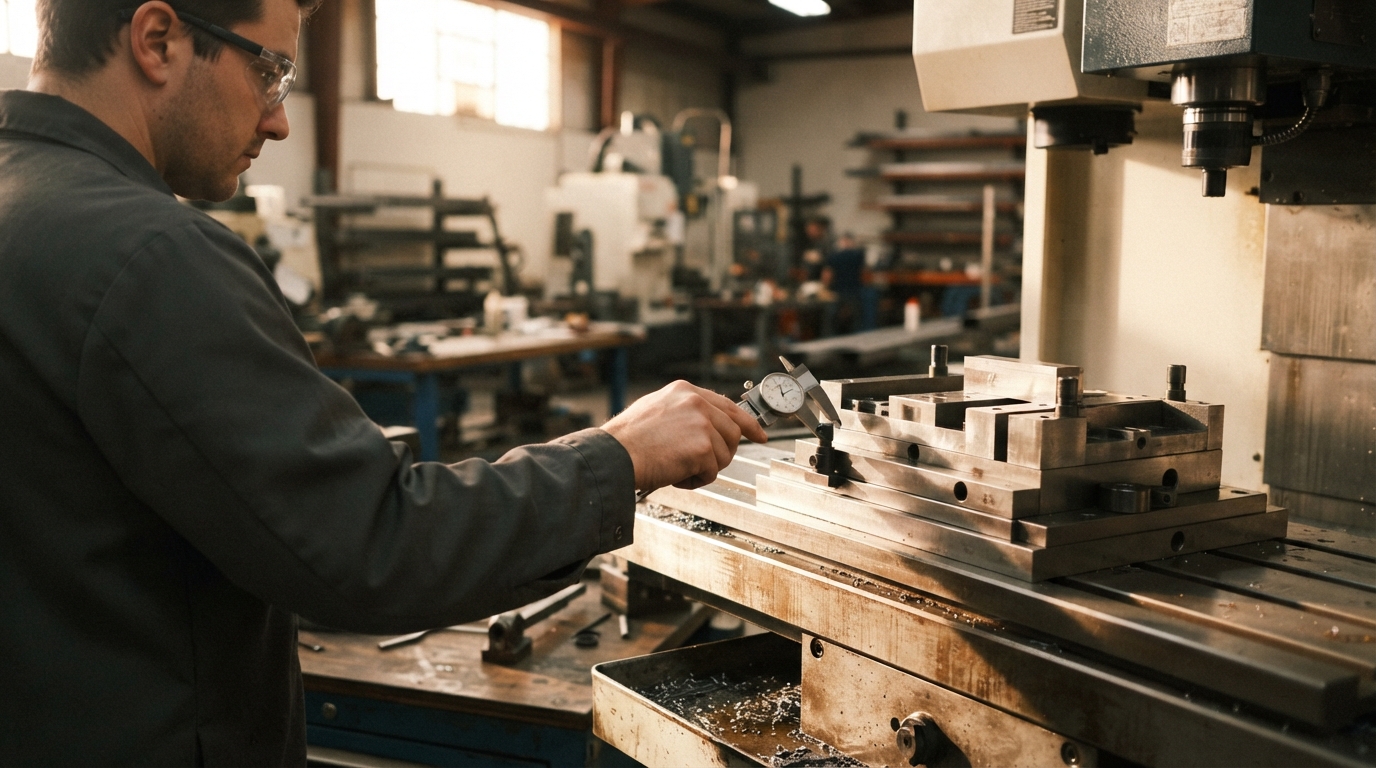
Tooling is the foundation of any stamped, formed, or hydroformed part. Without a properly engineered tool, even the best CNC equipment cannot guarantee a consistent finished product.
Several factors shape how a tool is designed before a job moves into production:
-
Quality requirements of the finished part
-
The part’s geometry and complexity
-
Speed and accuracy needed to produce it
-
Repeatability across the full production run
-
Budget constraints tied to the project scope
These considerations are weighed during the quoting phase, which directly shapes the final tool design and the production schedule that follows.
Tolerance control is a widely recognized benchmark in precision manufacturing. Standard machining typically holds tolerances around plus or minus 0.005 inches, while precision machining tightens that range considerably, according to NIST manufacturing standards guidance. Tooling built to match these tighter tolerances reduces scrap and rework on every subsequent part run.
The In-House Tooling Advantage
Outsourcing tool design to a separate vendor introduces delays every time a design changes. Shops that build tooling internally can react to modifications without waiting on outside suppliers or re-quoting a third-party job.
In-house tooling capability typically supports:
-
Hydro and cold forming applications
-
Sheet metal fabrication projects
-
Forging and extrusion work
-
Custom fixturing and gauging for hard-to-measure dimensions
Facilities with in-house machining can also build the tools, fixtures, and gauges needed to check dimensional quality throughout a production run rather than relying on external calibration services for every check. This keeps mission-critical parts under one roof, which reduces handling risk and supports higher-quality output across the full job.
Comparing Tooling Approaches
|
Approach |
Lead Time |
Design Flexibility |
Cost Control |
|
In-house custom tooling |
Shorter, adjustments made on-site |
High, changes handled internally |
Easier to manage with fewer vendor markups |
|
Outsourced tooling |
Longer, dependent on vendor schedule |
Limited, requires re-quoting for changes |
Harder to predict with added vendor fees |
|
Off-the-shelf tooling |
Fastest initially, but poor fit for custom parts |
Very low, no customization possible |
Lower upfront cost but higher long-term rework |
Questions to Ask Before Starting a Tooling Project
Manufacturers evaluating a tooling partner should clarify a few points before committing to a production run.
- What level of precision does the part require, and can the shop demonstrate it with measurement equipment on site?
- How will the tool handle expected production volume without excessive wear?
- Is the design finalized, or is this still an R&D phase that may require tooling adjustments later?
- What materials will the tool need to accommodate, since tooling for tool steels or high-permeability alloys differs from standard aluminum work?
Answering these questions early prevents mid-production surprises and keeps lead times predictable.
Frequently Asked Questions
What is tooling in metal fabrication? Tooling refers to the custom dies, molds, or fixtures built to shape, form, or hold a part during production. Each unique job generally requires its own tool to meet the part’s specific geometry and tolerance needs.
Why does in-house tooling matter for production accuracy? Building tooling internally allows a fabricator to adjust designs quickly when specifications change, which keeps dimensional consistency intact across an entire production run.
How does tooling affect lead times? Shops that design and machine their own tools can start production sooner because they are not waiting on a separate vendor to deliver or revise a tool.
Does tooling cost vary by material? Yes. Tooling for harder materials or tighter tolerances generally requires more machining time and specialized equipment, which can affect both cost and schedule.
Moving Forward With a Tooling Partner
Production accuracy depends on decisions made before a single part is formed. A fabricator capable of designing, machining, and adjusting tooling in-house gives manufacturers more control over cost, schedule, and dimensional quality from the first prototype through full production.
The MuShield Company is a Londonderry, New Hampshire based manufacturer known for precision sheet metal fabrication, magnetic shielding, hydroforming, and in-house custom tooling for aerospace, defense, and medical device applications. For manufacturers evaluating tooling options for an upcoming production run, Visit Website to review capabilities and request project details.